
Why enterprise cloud strategy needs a jurisdiction model

Residency answers where the data sits, while sovereignty answers who can be compelled to hand it over.
Several years ago, a sovereignty clause in a cloud tender usually meant a line about data residency, and a provider could satisfy it by naming a region. But that is no longer sufficient. Enterprise and public-sector cloud procurements increasingly examine which jurisdictions govern a provider's corporate structure, whether its parent company is subject to foreign disclosure laws, and who can access the control plane.
The shift is worth understanding, because it corrects a question the industry spent years answering in the wrong terms. A provider can satisfy every residency requirement in a contract, store every byte, pass the audit, and still face a lawful order to disclose that data from a court in another jurisdiction.
That is not a failure of configuration. It is a failure of framing, and it is the substance of the sovereign cloud debate.
Residency concerns where data is physically stored and processed, while data sovereignty concerns which jurisdiction’s laws apply to it.
The two are related but not equivalent and combining them is probably the most common failure in enterprise cloud strategy. Residency is the more concrete of the two, which is precisely why it tends to be treated as the whole answer. Regulations such as GDPR and APPI place conditions on cross-border transfers of personal data, which can make data location an important architectural consideration without necessarily requiring all data to remain within a particular country.
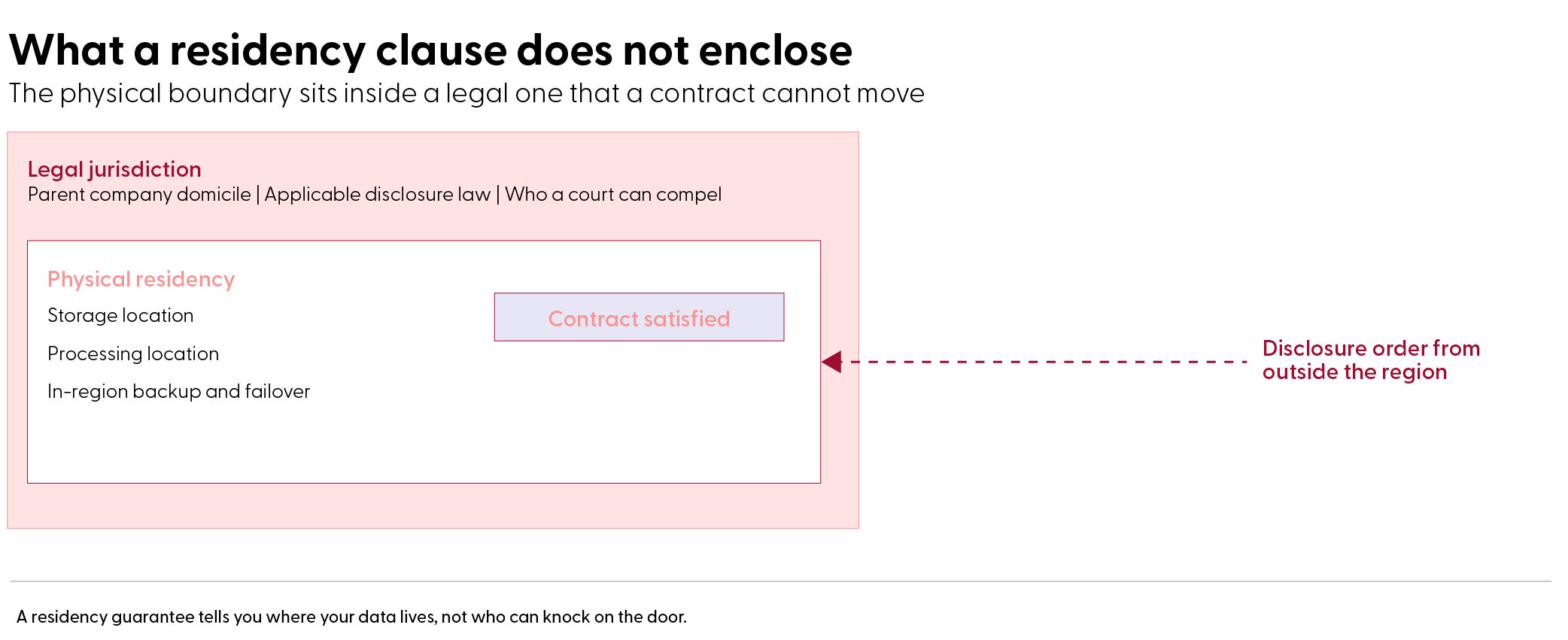
Residency is therefore necessary but not sufficient. It has to sit alongside data inventories, classification, and governance that establish what is flowing where and under whose control. That work belongs before the architecture decisions are finalized.
The common approach treats sovereignty as a hosting question, which tends to produce a lift-and-shift into a compliant region. A more comprehensive approach also examines the control plane: who can provision, administer, scale, and manage the environment, and which dependencies remain under provider control. Open and portable technologies can reduce reliance on provider-specific services, but the appropriate architecture depends on the organization's sovereignty requirements.
Several properties must be held together rather than as separate workstreams. Data planes stay region-bound with boundaries that are enforced, rather than declared. Operator access is controlled and logged, including access by the vendor’s own staff. Encryption keys sit with the customer, logging remains immutable with a protected chain of custody, and orchestration stays portable under policy-bound automation.
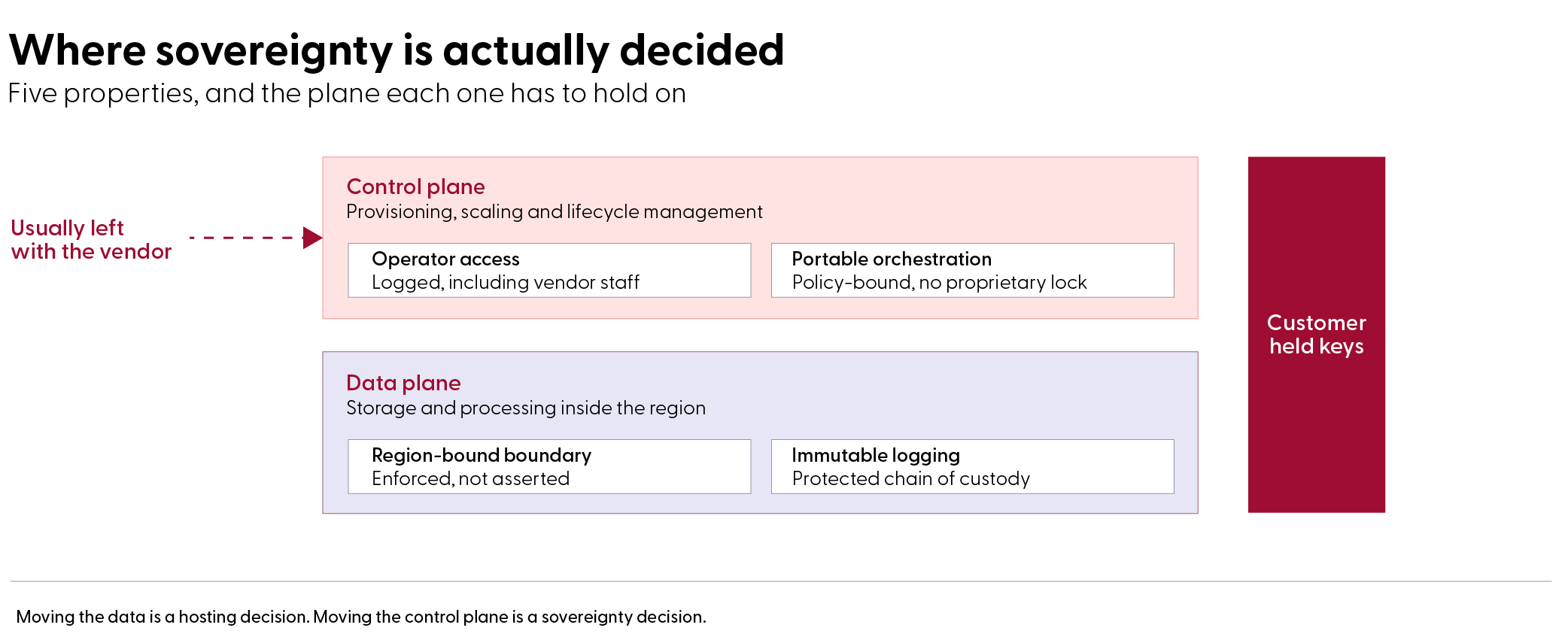
Customer-controlled encryption keys can strengthen sovereignty by giving the organization greater control over key generation, rotation, revocation, and access. Depending on the architecture, revoking access to a key can prevent the provider from decrypting protected data.
The level of assurance depends on where keys are generated, stored, and administered, and whether the cloud provider retains any technical ability to access them. For higher-assurance workloads, organizations may choose external or independently controlled key-management arrangements.
This is the trade-off most sovereignty programs leave unresolved. Sovereign environments are often deliberately isolated to meet compliance requirements, and that isolation restricts integration with third-party applications and makes moving workloads between sovereign and non-sovereign environments difficult.
The mitigations are open formats, modular architecture, and testing portability regularly rather than assuming it. We examine the same tension between coordination and independence in multi-cloud vs hybrid cloud: the architecture debate in 2026. In a sovereignty program, however, the constraint is legal rather than architectural, which removes the option of resolving it through design alone.
The cost argument runs the same way. Applying maximum sovereignty controls across an entire cloud estate can increase cost and slow delivery, because the workloads that require jurisdictional isolation are a subset. Total cost is also easy to underestimate, since much of it is operational rather than infrastructural: compliance tooling, audit cycles, specialized staff, and the overhead of maintaining evidence.
Certifications can provide evidence that defined security and compliance controls have been assessed, but they do not necessarily answer which jurisdictions govern a provider's corporate structure, operations, personnel, and processing, or under what circumstances a foreign authority could compel access to data.
Procurement has moved from aspiration to interrogation, so government buyers now specify evaluable sovereignty criteria in tender documents. Under the US CLOUD Act, qualifying legal orders can require US service providers to produce data within their possession, custody, or control even when that data is stored outside the United States, subject to applicable legal procedures and grounds for challenge.
Evidence standards have tightened alongside. Buyers increasingly ask for architectural documentation, data processing agreements, and third-party audit reports rather than relying on marketing claims alone. The European Commission's Cloud Sovereignty Framework, published in October 2025, evaluates cloud providers across eight sovereignty objectives, including legal and jurisdictional sovereignty, data and AI sovereignty, operational sovereignty, and technological sovereignty. The Commission subsequently applied the framework to its own sovereign-cloud procurement under the Cloud III Dynamic Purchasing System.
The recurring failure is organizational rather than technical, because procurement, legal, and engineering arrive at the same program using the same word to mean different things. Legal means jurisdictional exposure, engineering means region configuration, and procurement often means whatever the vendor questionnaire happened to ask.
The certificate is what allows that disagreement to survive, because it gives all three a document to point at and a date on which the question appears settled. No one has to reconcile the three definitions while the audit report is current. The gap surfaces later, when a regulator asks a question none of the three had been answering.
Treating sovereignty as a standing control forces reconciliation up front, because a control has to be specified before it can run. In practice, that means formalized evidence pipelines, jurisdiction-scoped identity models, and a record of what must be sovereign, why, and who approves exceptions. All of it requires the three functions to agree on terms before anything is built.
This is why tender language is a useful signal. Those questions ask for things a region selector cannot answer: who holds the keys, who can reach the control plane, and which court can compel them. Data sovereignty was always settled on those terms. Until buyers began writing them into contracts, providers were rarely asked to say so.
For enterprises setting or renewing their cloud strategy, the decisive question is no longer simply where the data sits. It is which jurisdictions can reach it, who can operate on it, who controls the keys, and whether the organization can produce evidence for each on demand.
Residency was never the wrong question. It was the easy one, and it is no longer the only one being asked.
