
Why Modern Software Delivery Depends on Environment Alignment

The real challenge in modern software delivery is not how quickly code can be deployed, but whether the systems used to test and release it reflect real-world conditions. When development, testing, and production operate as separate realities, the distance between assumptions and outcomes becomes the source of most avoidable failures.
Most organizations know they have environmental silos. Fewer recognize that those silos are not an accident of tooling but a structural decision made by default, compounded daily, and felt most acutely when something fails in production.
A developer writes code against a local database with synthetic data. A tester validates it in a staging environment configured months earlier by someone who may no longer be with the organization. Operations deploys the release into a production system behaving under entirely different conditions. By the time something breaks, the chain of assumptions is so long that tracing accountability becomes difficult.
This is the silo problem in its operational form. The issue is not that teams refuse to communicate. It is that the dev test production environments they rely on evolve independently, encoding different versions of reality over time until those inconsistencies surface under pressure.
Continuous integration, continuous delivery, and continuous monitoring are often described as engineering practices. They are better understood as a shift in where trust lives inside a software system.
In a traditional pipeline, trust exists at the handoff. Development teams rely on testing teams to identify what was missed. Testing trusts production to behave like staging. Each transition becomes a bet, and while most bets succeed quietly, failures do not.
Continuous systems replace handoffs with visibility. When every code change triggers automated builds, when tests execute continuously against a shared codebase, and when monitoring becomes part of the deployment pipeline rather than an afterthought, trust stops depending on assumptions between teams and starts being maintained by the system itself.
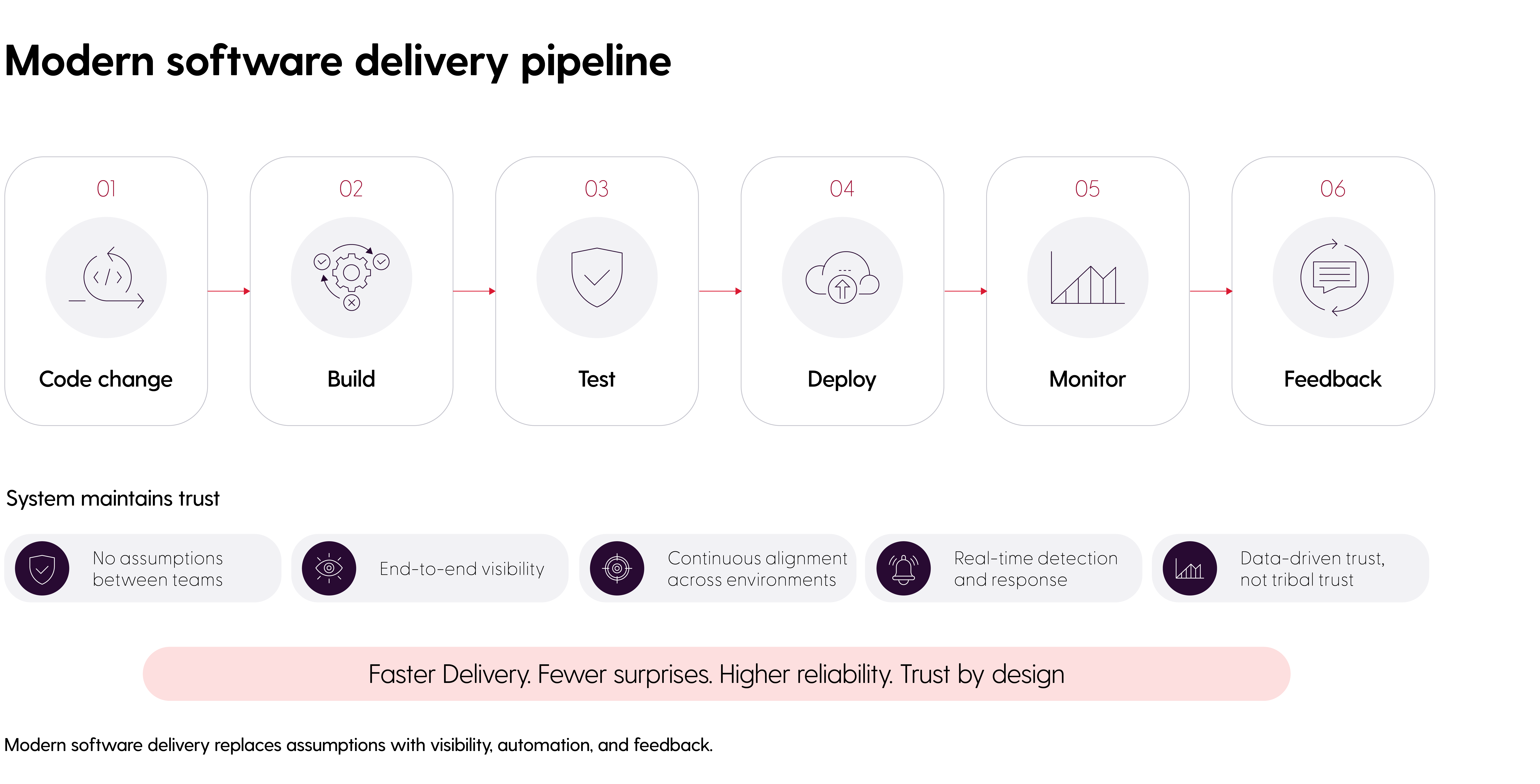
The practical result is that defects surface closer to the point where they are introduced rather than weeks later in production. Remediation costs fall not because teams move faster, but because feedback loops become shorter and clearer.
Development and staging environments are useful, but production is where software faces real users, real traffic, and unpredictable behavior. Modern teams are no longer trying to eliminate every production risk before release. Instead, they are building systems that continuously monitor, adapt, and improve in production itself.
Practices like canary releases, blue-green deployments, feature flags, and gradual rollouts are no longer considered risky experiments, but have become disciplined approaches that make deployments safer, more observable, and easier to control in real time. The focus has shifted from avoiding production exposure to building confidence directly within live environments.
At VRIZE, we increasingly see organizations struggle not with deploying pipelines, but with maintaining operational consistency across fragmented environments, tools, and teams. It is building connected delivery ecosystems where visibility, monitoring, and accountability remain aligned throughout the software lifecycle.
With this in mind, we design modern delivery pipelines around continuous visibility instead of isolated handoffs between teams. Automated builds, continuous testing, integrated monitoring, and deployment feedback loops help development, QA, and operations teams stay aligned throughout the software lifecycle. Monitoring is no longer treated as an “after-deployment” activity but becomes part of the process itself.
We’ve observed that the organizations succeeding with continuous delivery are not the ones relying solely on sophisticated staging environments, but the ones recognizing that no test environment can fully replicate live production complexity. Shared observability and continuous alignment across environments are becoming critical to reliable software delivery.
When development, testing, and operations teams work in separate environments with different tools and priorities, silos form structurally. Developers optimize for delivery, testers optimize for validation, and operations optimize for stability. Each team improves what it controls. The result is slower releases, configuration drift, and reactive troubleshooting during production incidents.
Modern software deployment pipeline strategies change that dynamic by creating shared visibility across the full delivery lifecycle. When developers have access to production monitoring data, they build more observable applications. When QA teams see real production signals, testing aligns more closely with actual user behavior, and when operations participate directly in pipeline automation, issues are identified before they become operational failures.
Automation enables this shift, but it does not replace human judgment. Effective delivery pipelines combine automation with contextual decision-making, where automated systems validate known scenarios while teams focus on edge cases, system interactions, and unpredictable behaviors.
As AI-assisted tooling becomes embedded in software engineering workflows, teams are gaining faster visibility into testing gaps and deployment anomalies. As explored in our whitepaper on AI-Driven Product Engineering, intelligent systems are accelerating test generation and operational insight, but effective delivery still depends on teams applying context and experience to what those systems surface.
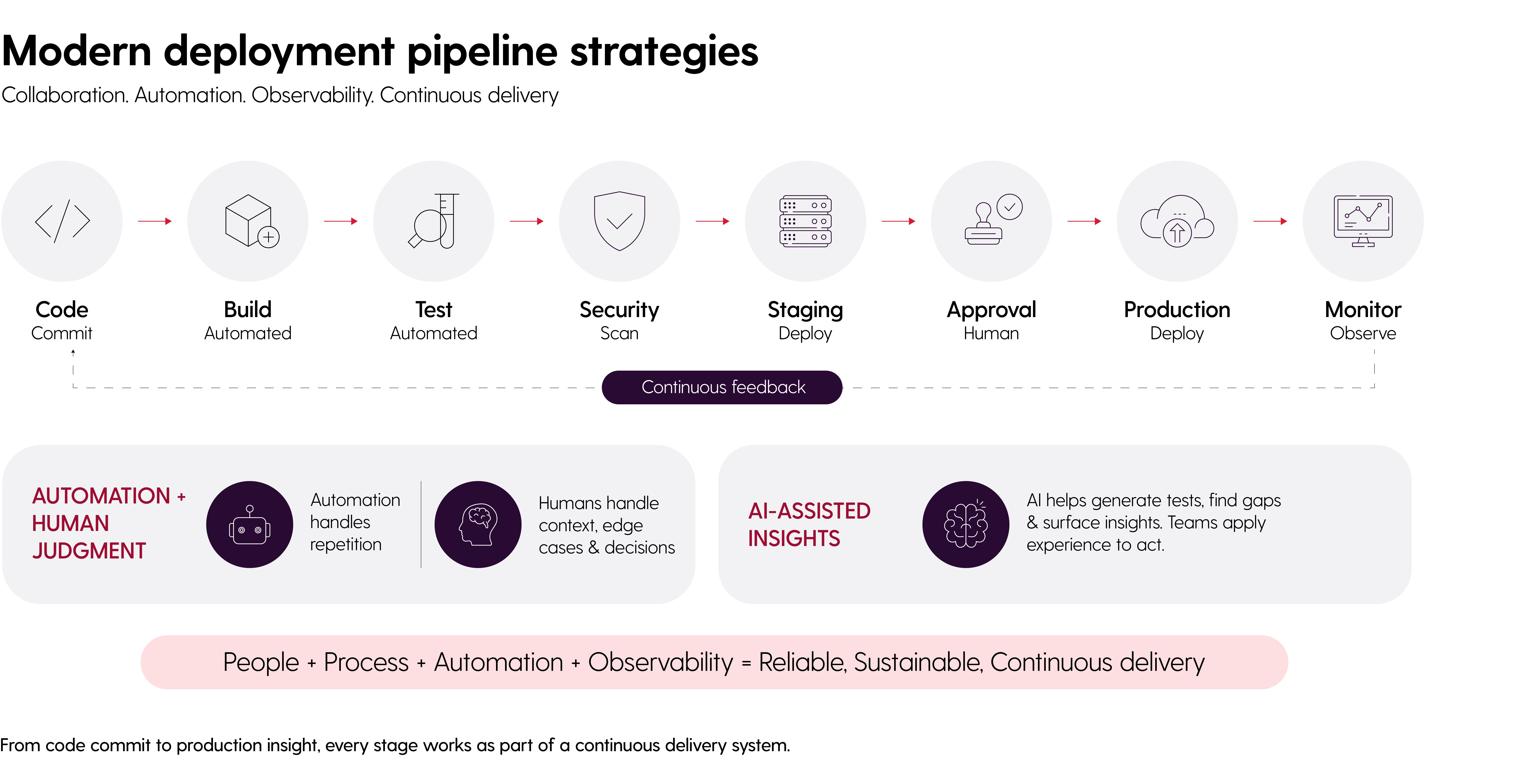
Leading organizations are moving toward connected delivery ecosystems where development, testing, and production environments remain continuously aligned throughout the software lifecycle. When environments operate in silos, teams face configuration drift, inconsistent testing conditions, delayed issue detection, and reactive troubleshooting. Continuous delivery pipelines reduce those gaps by creating shared accountability, visibility, and operational consistency across engineering, QA, and operations.
The organizations making the strongest progress are treating delivery pipelines not as isolated engineering workflows, but as operational systems that connect development, QA, observability, security, and production intelligence into a unified delivery model.
This transformation is not only technical but also structural. Quality is no longer owned by a single team or validated only before deployment, but becomes a continuous property of the system itself, maintained through automation, observability, governance, and human oversight, all working together.
Modern software delivery is no longer defined by how quickly code moves through a pipeline, but by how consistently systems, teams, and environments remain connected throughout the lifecycle. Organizations that build observable, aligned, and continuously adaptive delivery ecosystems will be significantly better positioned to scale software reliably in increasingly complex operational environments.
